 Merry Japan Tours
BLOG
Let’s Create Your Own Amulet Bracelet at Korin, Kyoto
Kyoto KORIN offers valuable and spiritual experiences—you can create your own amulet bracelet or Buddhist prayer beads, which are similar to a rosary. Prayer beads are worn to convey our voice of the heart not only to Buddha, but also to those who passed away.
Also, prayer beads are believed to have telepathic power, in which we can send inner messages, such as cheering, taking care, and believing, to those who are in close relationships like family members, friends, or fiancées.
Whether or not you are a Buddhist, wearing the Buddhist rosary can be interpreted as an expression of dedication to those who you think are in lifelong relationships with you; of course, everyone is allowed to wear one, regardless of their religion.
This time, I went to this workshop to create my own amulet bracelet. The experience fee for making an amulet bracelet is 8,800 yen per person. By reading this article, you can get the whole picture of what this experience is about, and artisanal spirits for making or repairing Buddhist rosaries that backstage artisans have.
Contents
At the North end of Higashi Hongan-ji Temple, Kyoto KORIN is located.
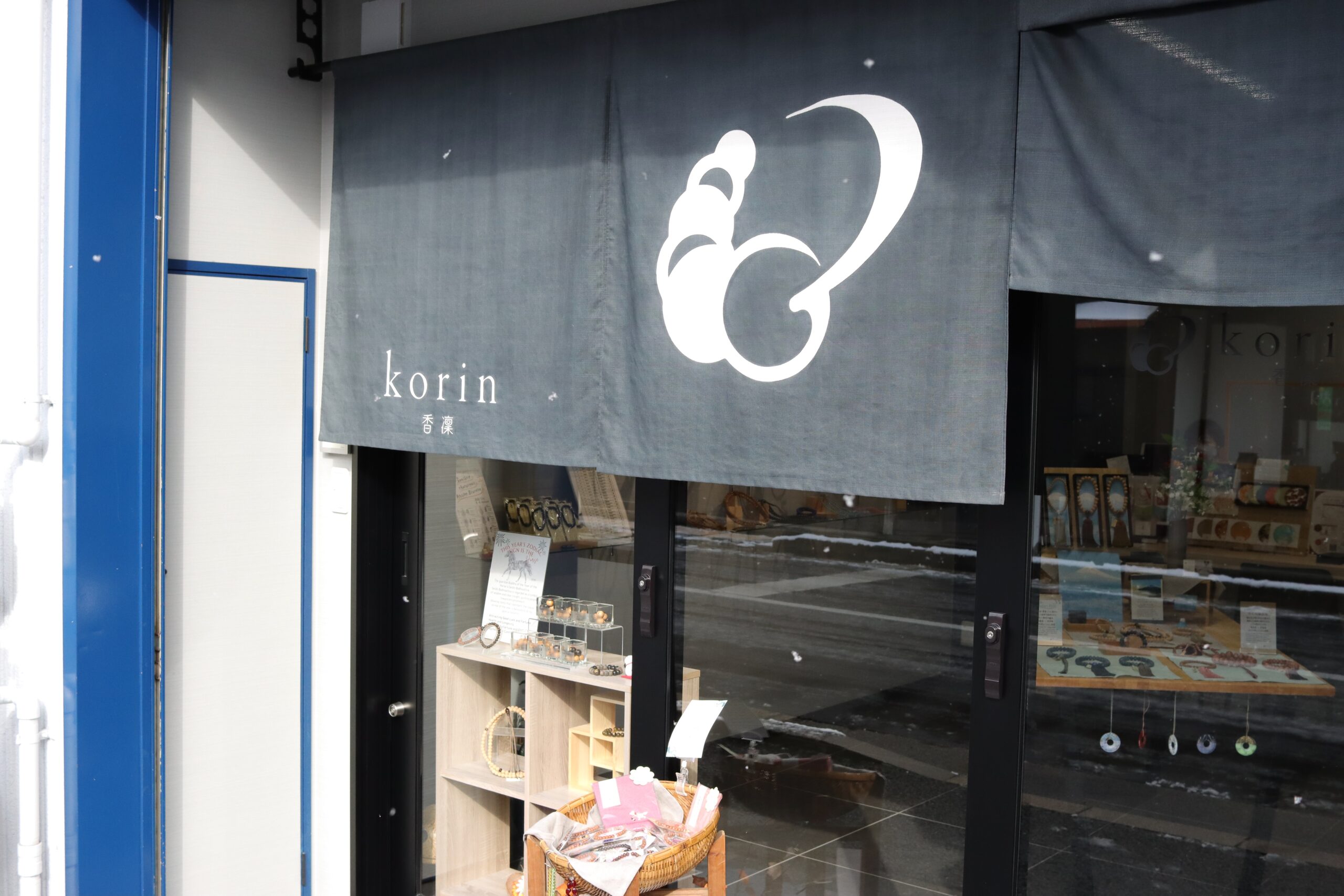
A 5-minute walk from Gojo Station will get you to Kyoto KORIN, which is located at the North end of Higashi Hongan-ji Temple, one of the renowned Buddhist temples that has lots of important cultural properties. The shop’s logo design is so attractive that you can easily find the location.
It’s about a 13-minute walk from Kyoto Station to get to this shop, so if you happen to stay near Kyoto Station, walking to this shop could be an option because there are several great sightseeing spots on the North side of Kyoto Station, such as Nishi Hongan-ji Temple, Higashi Hongan-ji Temple, and Shosei-en Garden.
Upon entering this shop, you will see many Buddhist rosaries and amulet bracelets, so I recommend you come to this shop about 15 minutes earlier than the starting time of the experience. Then you can browse and get some inspiration for your own amulet bracelet.
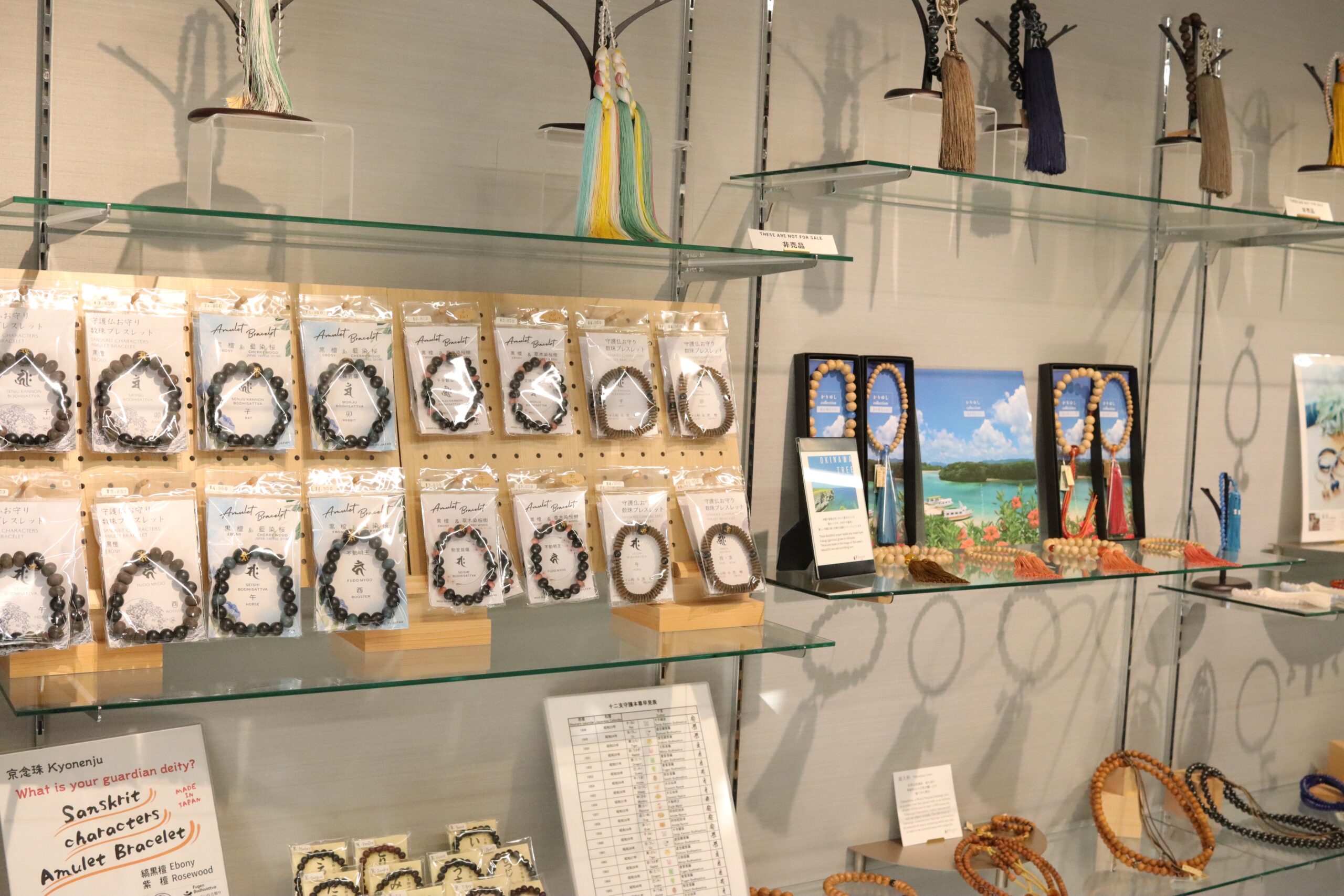
One of the amulet bracelets that caught my fancy was the one made with Japanese cedar, which is so light to wear around my wrist.
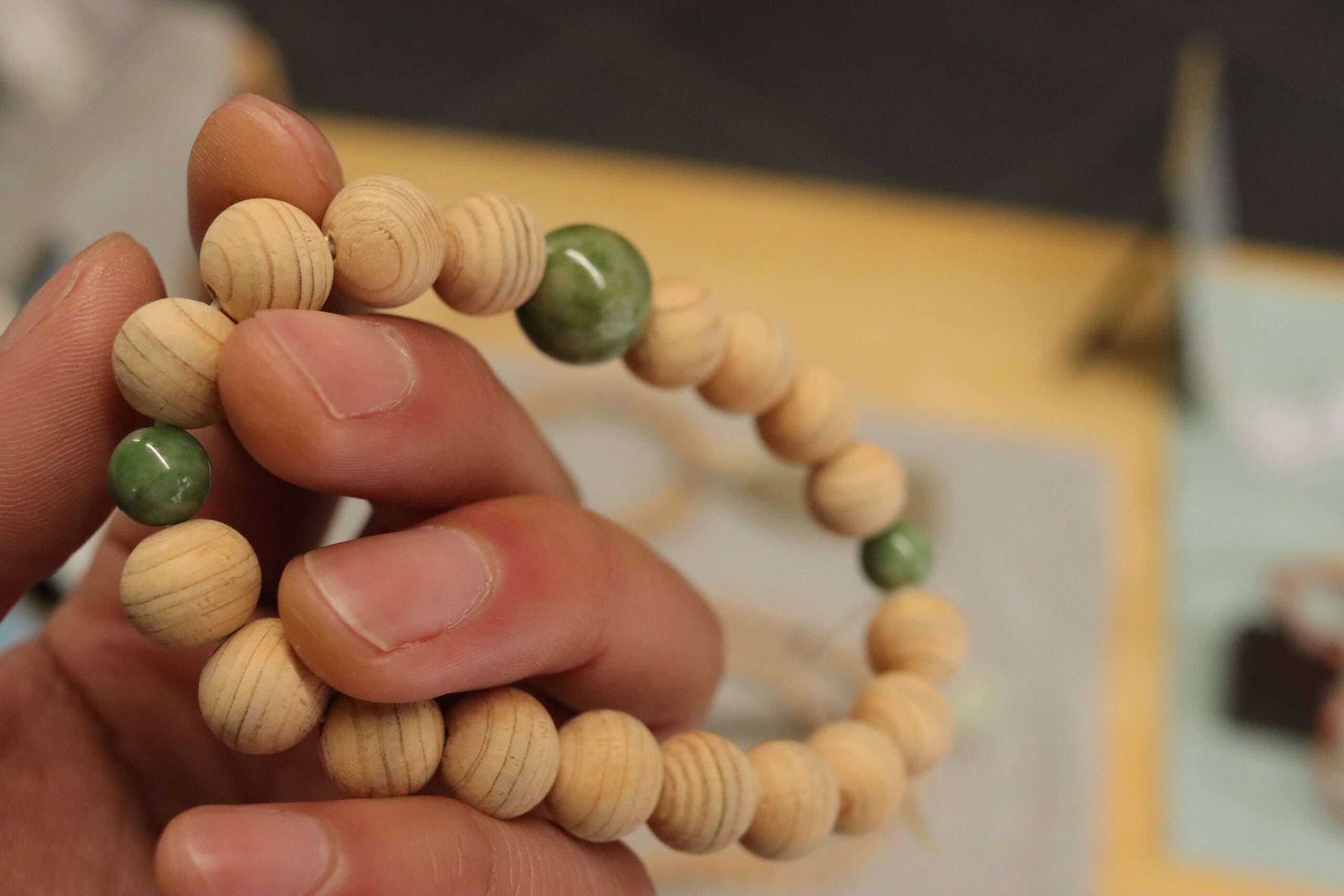
These Buddhist rosaries are used at a funeral, and the types of Buddhist rosary differ according to the sect of Buddhism; if one belongs to the Jodo Shin sect, he or she needs to use the one with a long tassel. In addition, the way of having a Buddhist rosary in one’s hands also differs from sect to sect.
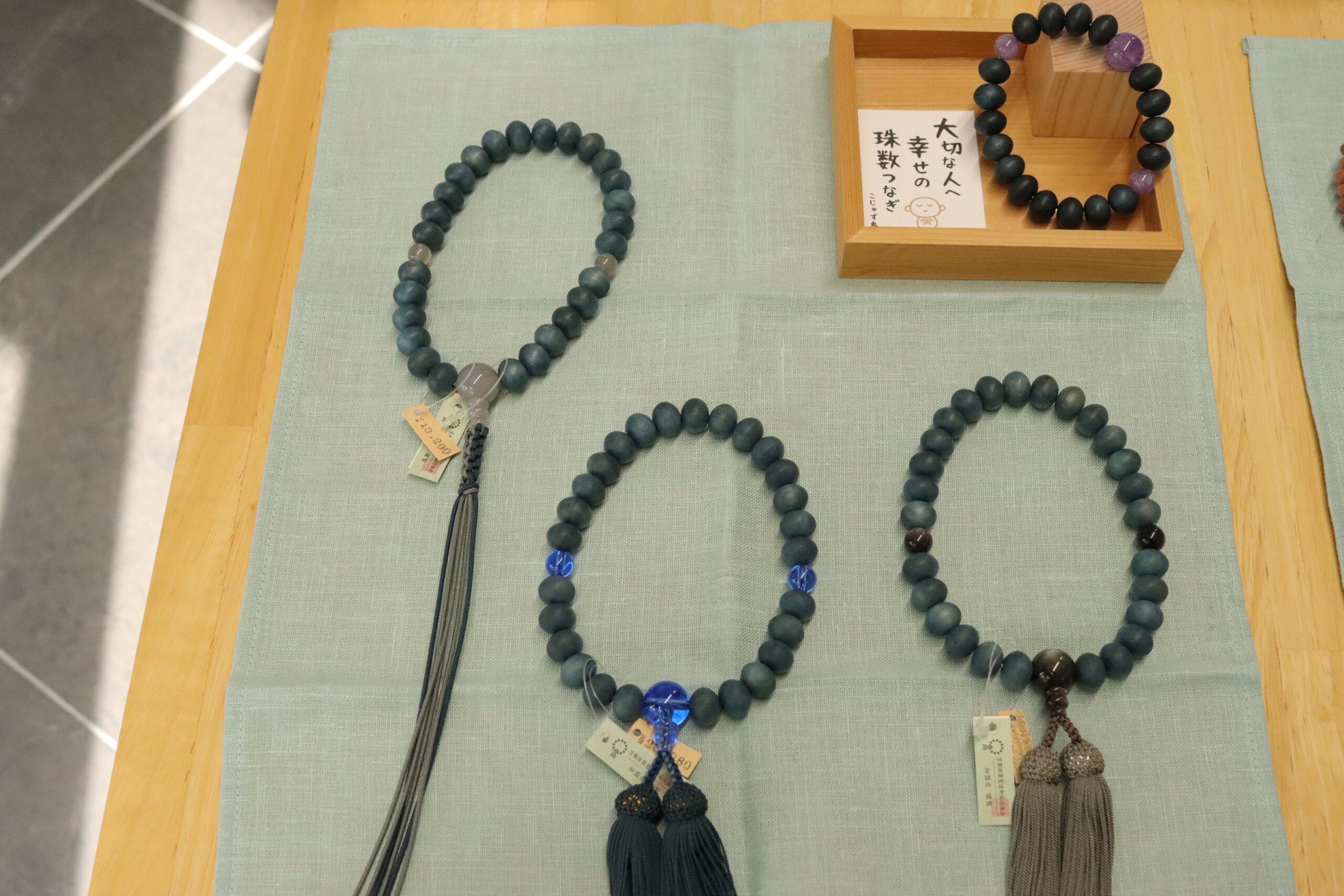
Go upstairs, and there’s a workshop
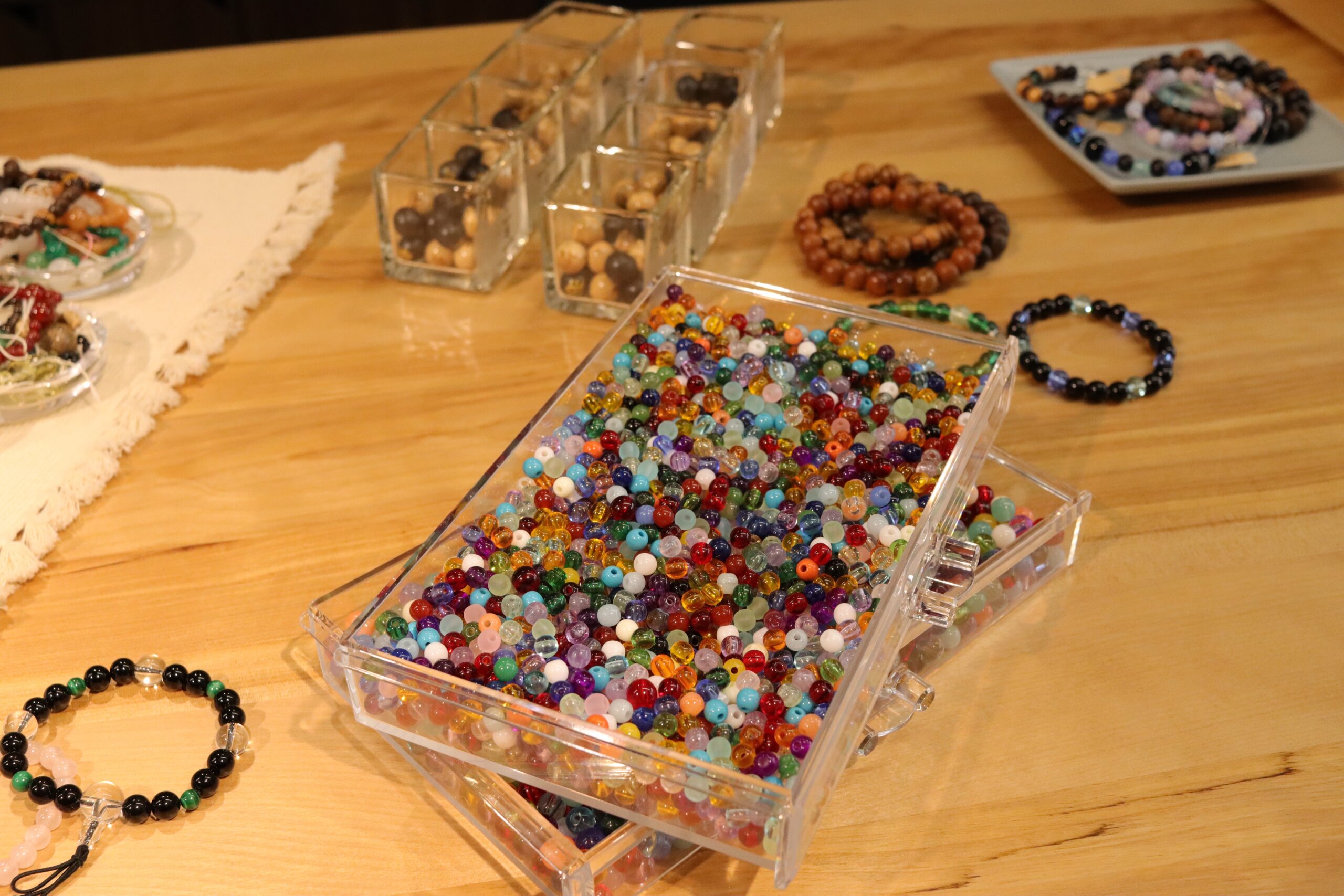
After browsing the shop and getting some inspiration, let’s go upstairs and have an experience! The workshop has a big table and chairs, and lots of beads are stocked. You can choose from a vast selection of beads—thousands of combinations allow you to create a one-of-a-kind bracelet!
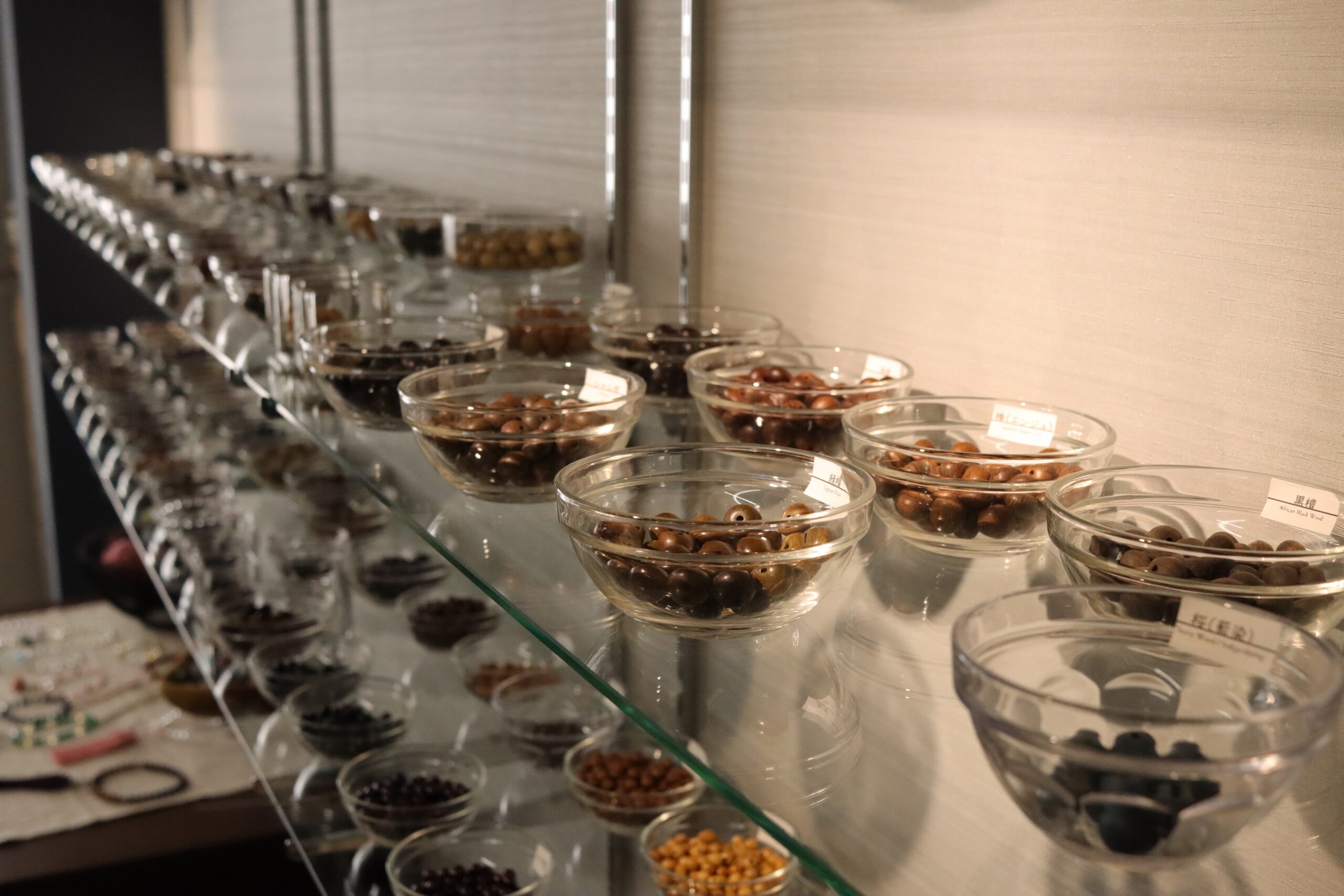
The beads come in wood or stone, but popular beads among Western visitors are wooden beads. This workshop collects beads from all over, and I assure you that you can find your favorite beads. As for the wooden beads, there are beads with the Sakura tree, Hinoki cypress, and the Bodhi tree, and more!
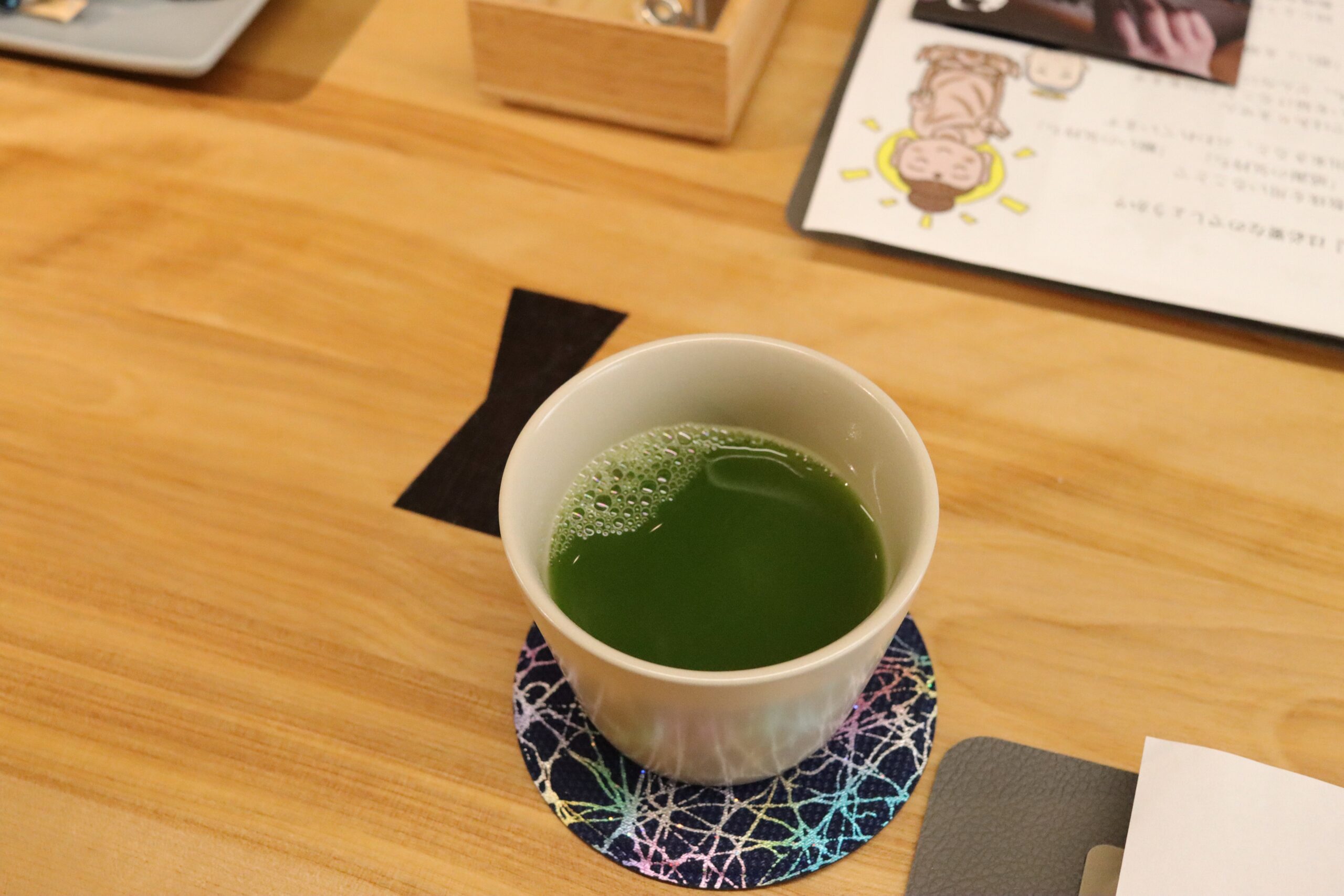
Before having the experience, why not have a cup of green tea? The green tea is not bitter; it’s sweetened to accommodate the taste of foreign visitors. Let’s enjoy the experience while relishing the sweet green tea!
Let’s make a one-of-a-kind amulet bracelet!
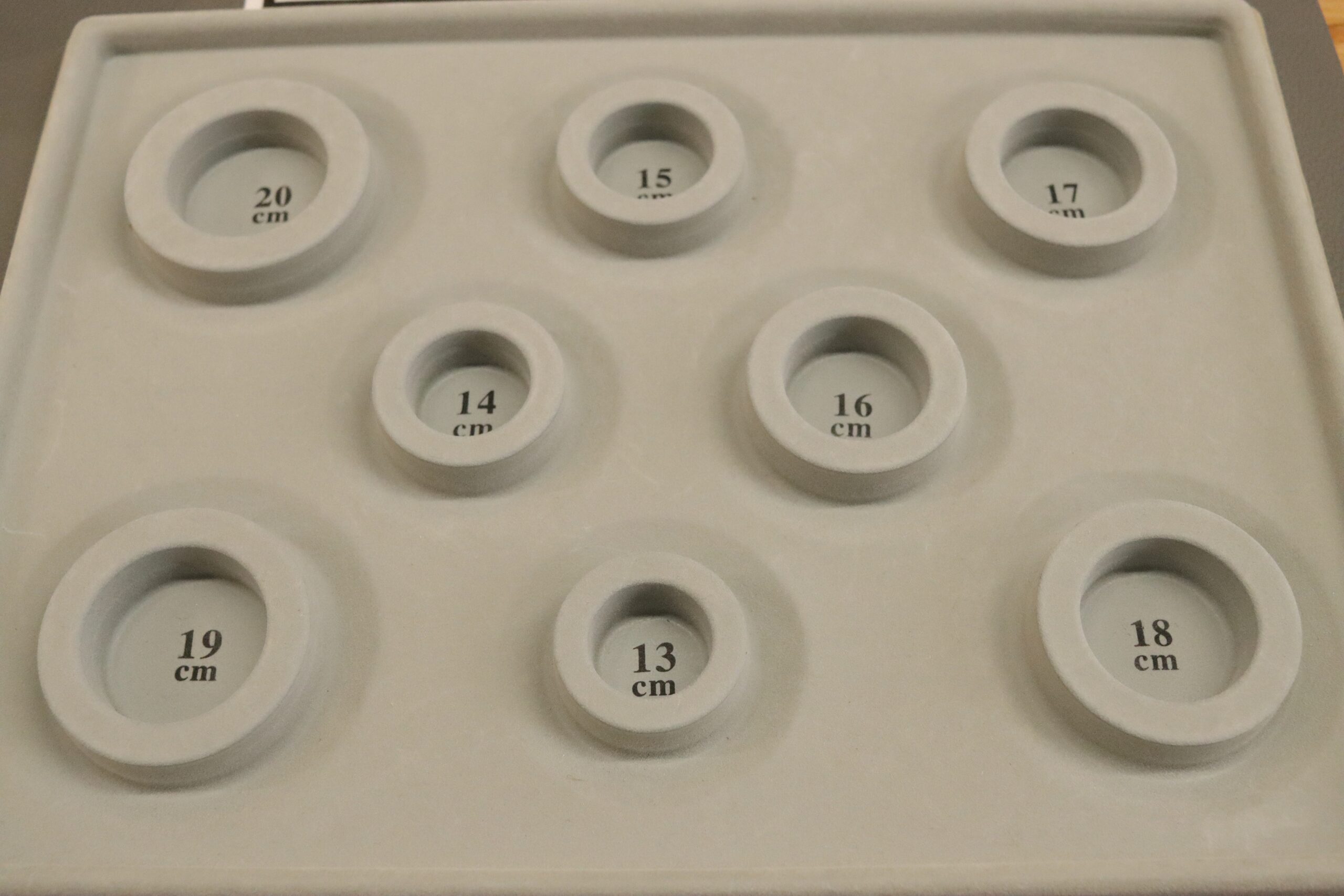
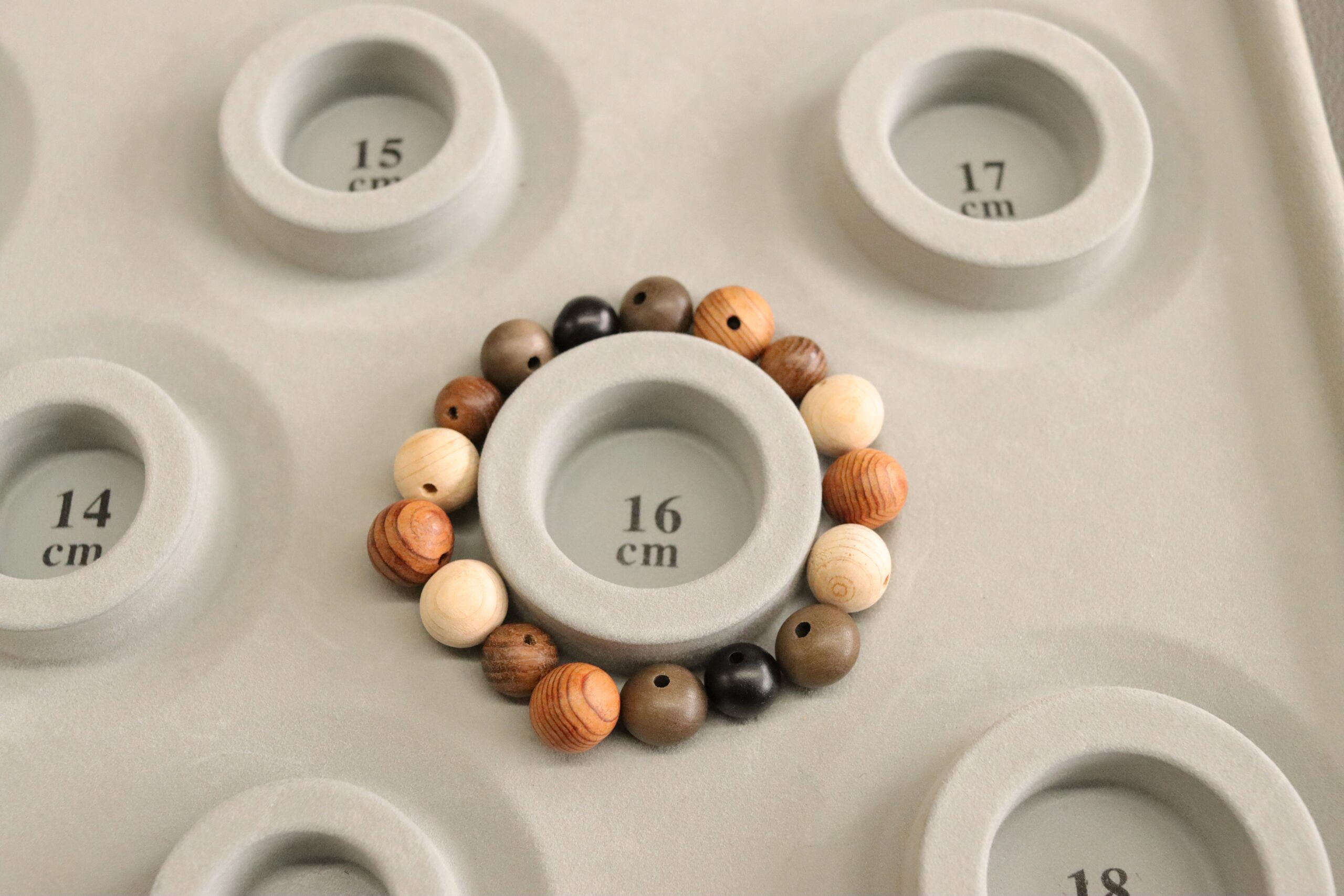
First of all, I needed to measure the length of my wrist. It turned out to be 16cm. After I measured my wrist,I just put beads around a 16cm circle.
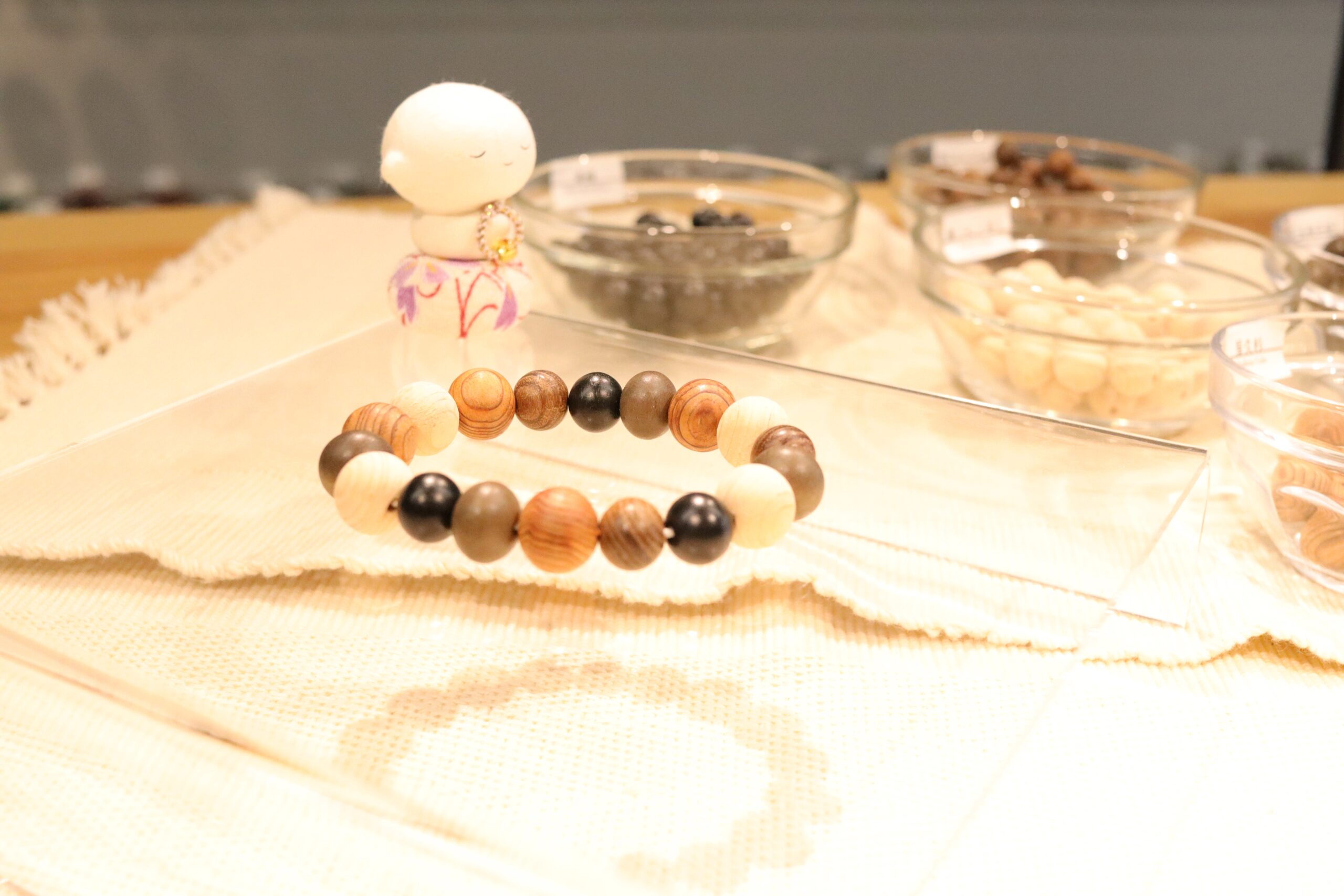
This time, I selected 5 different types of wooden beads: Yakushima Cedar, Japanese Pagoda Tree, Cherry Tree, Ebony, and Japanese Cypress. The workshop artisan told me the Japanese Pagoda Tree has a magical power to drive out evil spirits and avoid misfortunes. As I noticed, the color balance was important for the prayer beads to look good, so I intentionally included white cypress and black ebony.
It may be a good idea to include beads that have a meaning, like the Japanese Pagoda Tree, so that your bracelet will be your good luck charm!
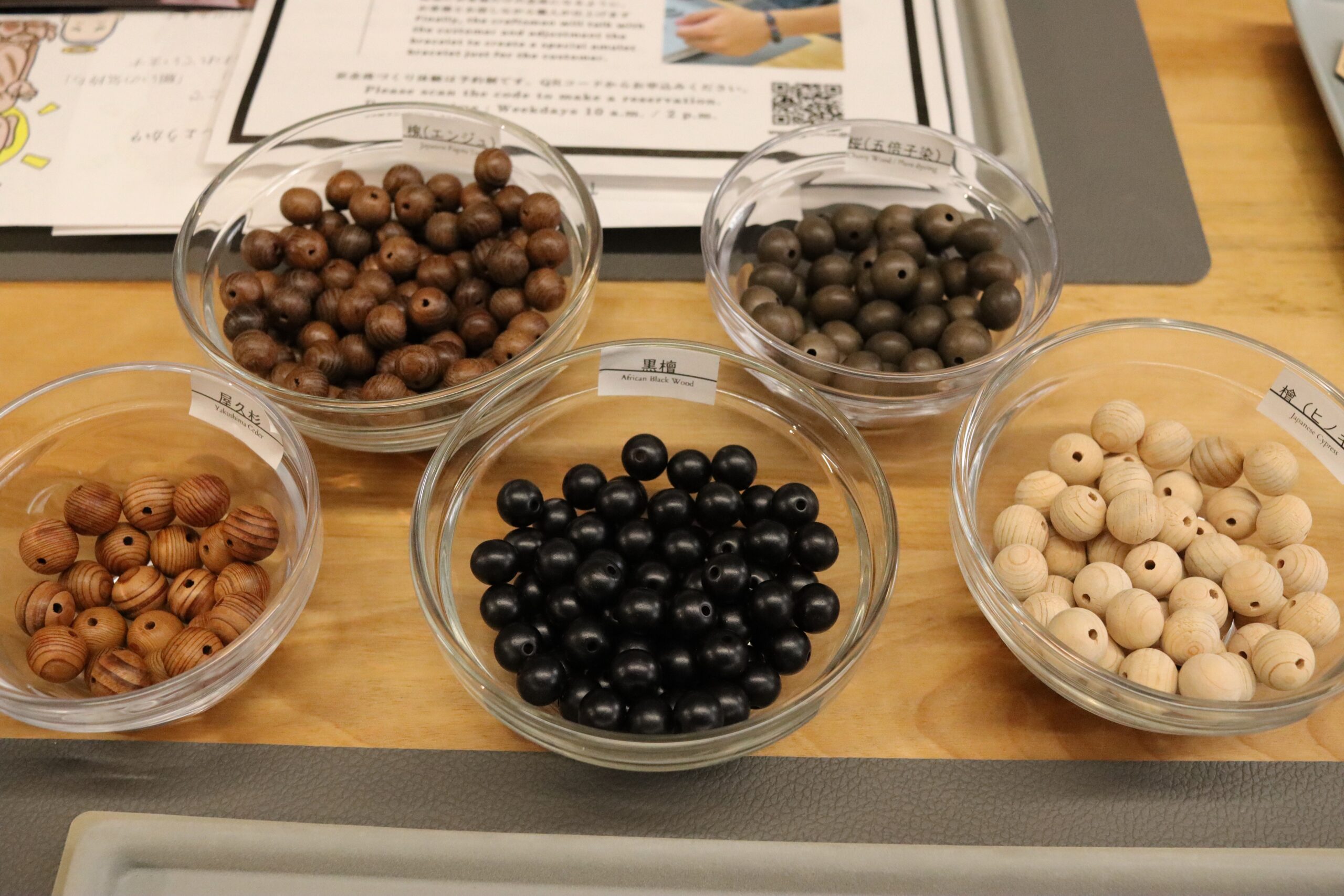
The next step is just putting the beads I chose around the circle. It’s easy, but I believe it takes some kind of design sense to arrange them beautifully. This step is very important, so I recommend you take time arranging the beads.
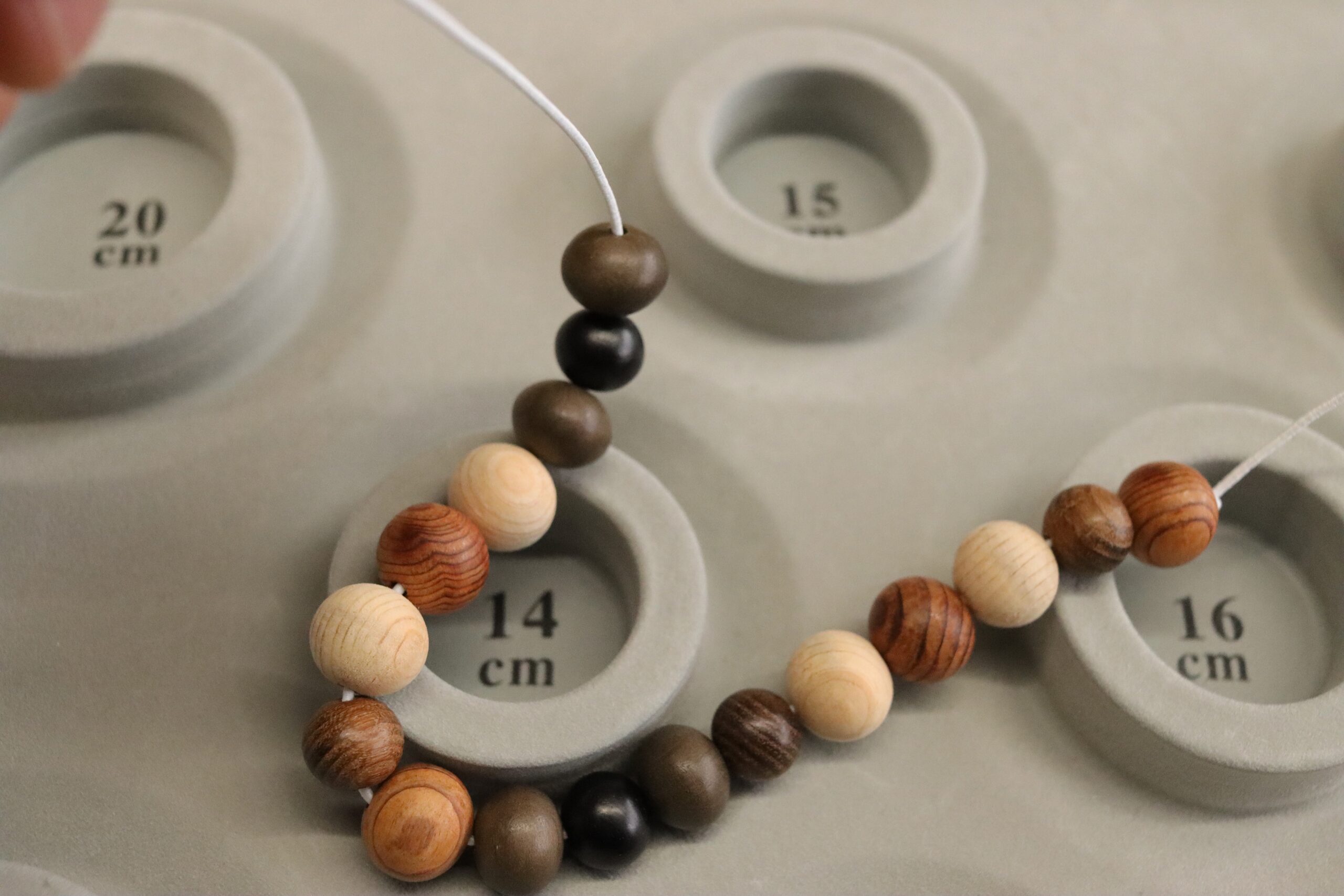
Next, I put the thread through the small holes of the beads. This step could possibly be a bit difficult for those who are all thumbs, so if you feel you are not good at it, a kind artisan is always by your side during the experience to help you with that.
This time, I asked for the kind artisan’s help, though I tried it myself halfway through, and he kindly helped put thread through them.
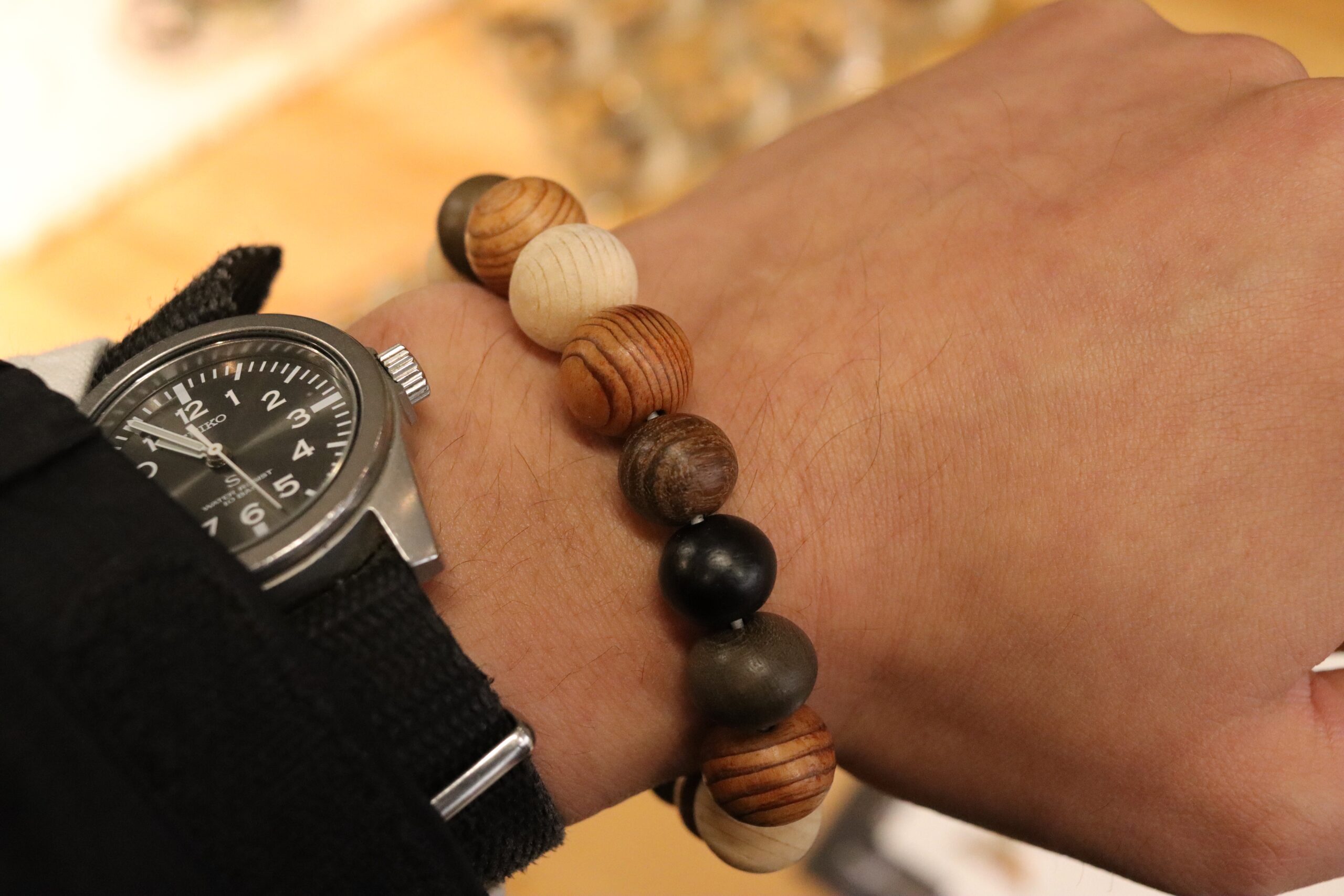
Finally, I tried wearing it on my wrist. Though I had already measured my wrist beforehand, there was room for another two or three beads to be added, so I found out that it was very important to try wearing it on my wrist, even if I thought it was done.
After finishing it, why not take pictures of the amulet bracelet you created? It’s surely Instagrammable. Behind the amulet bracelet in this picture is Jizo, a guardian deity for children and travelers.
Let’s dig deep into prayer beads at a detached workshop!
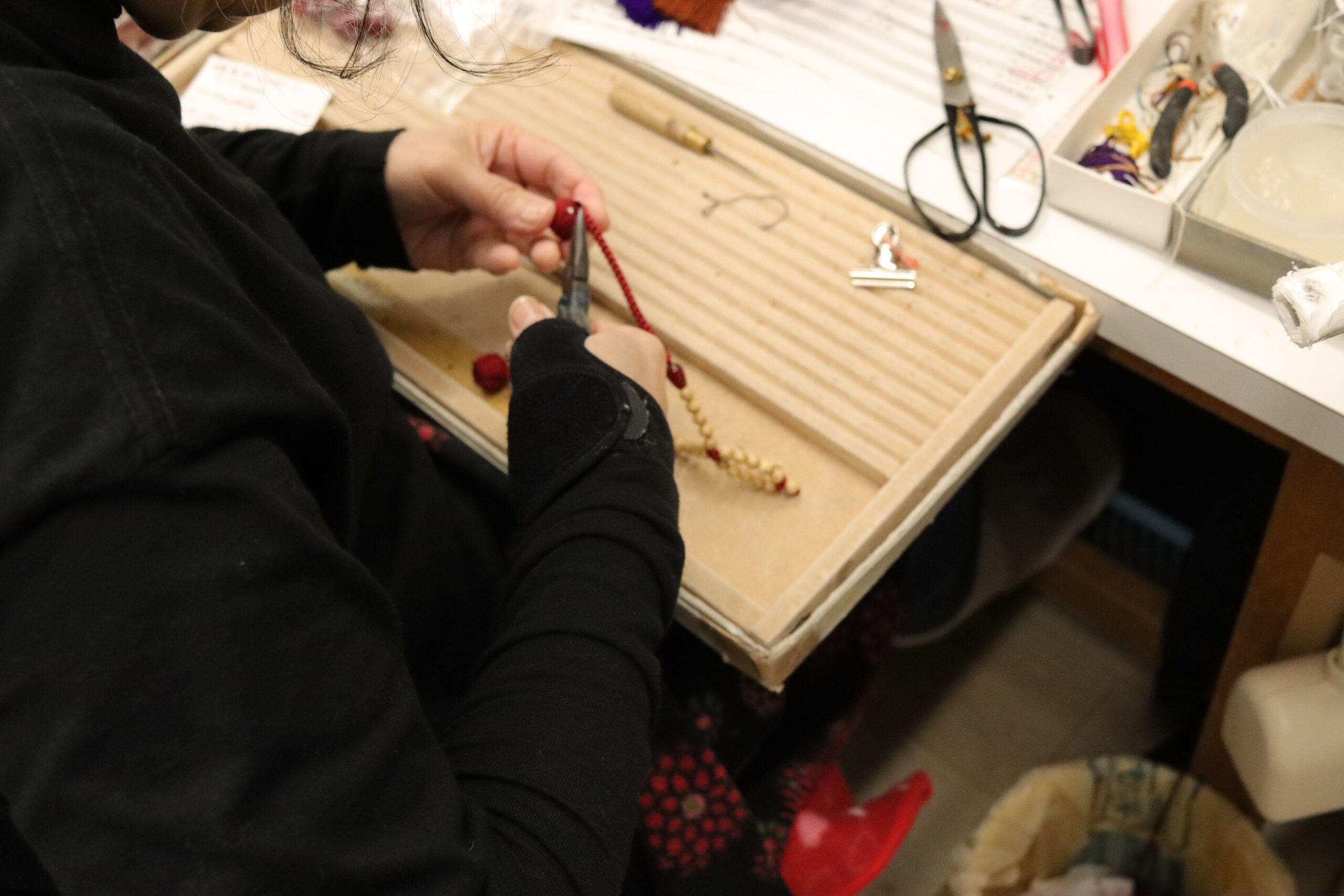
After finishing the experience, I walked just 3minutes to a detached workshop to learn more about the creation and repair process of prayer beads. It’s up to you whether you go to the workshop with the tour. If you have time and feel inclined to do that, an additional fee of 3,300 yen per person is needed. This optional experience is available for guests aged 12 and over.
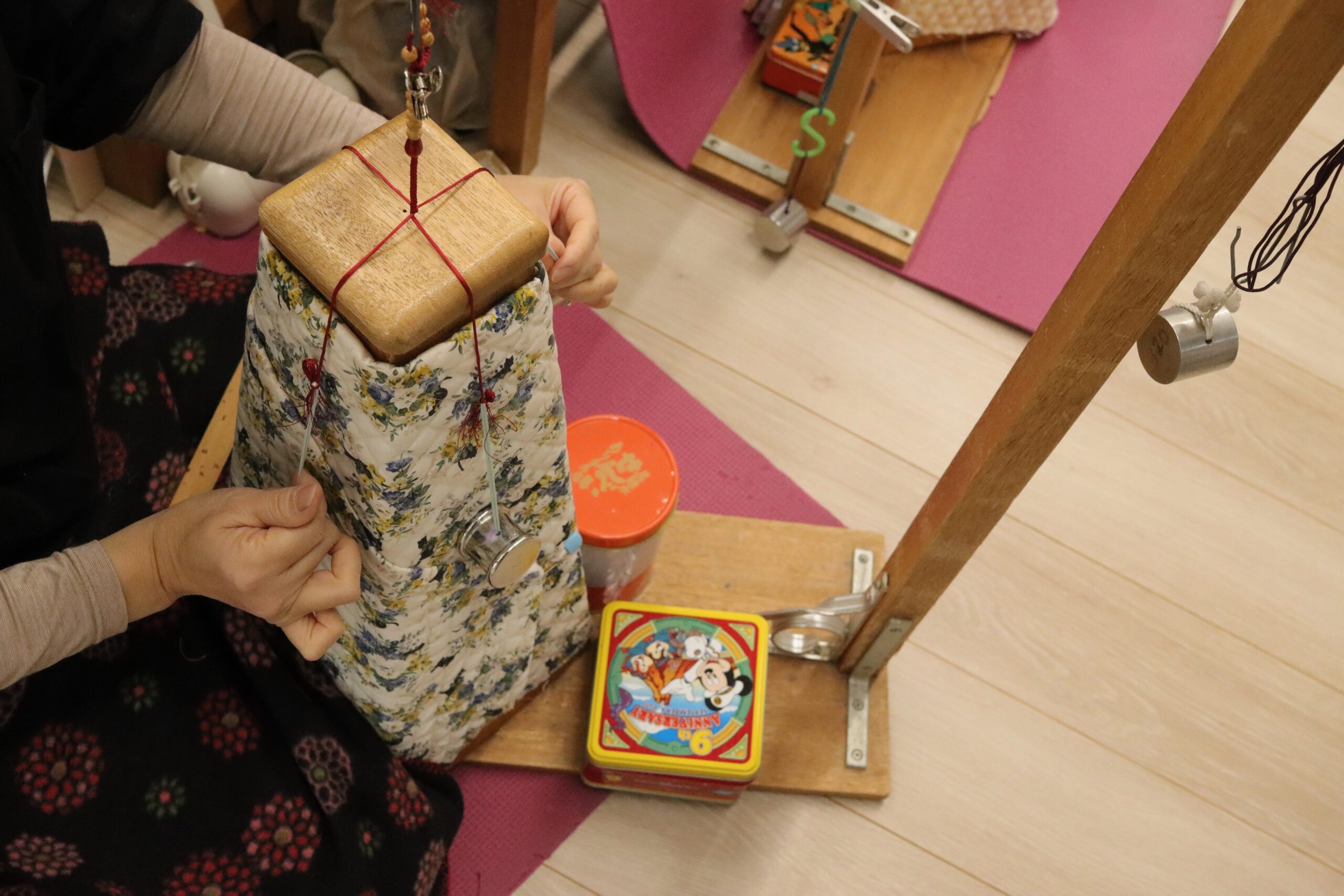
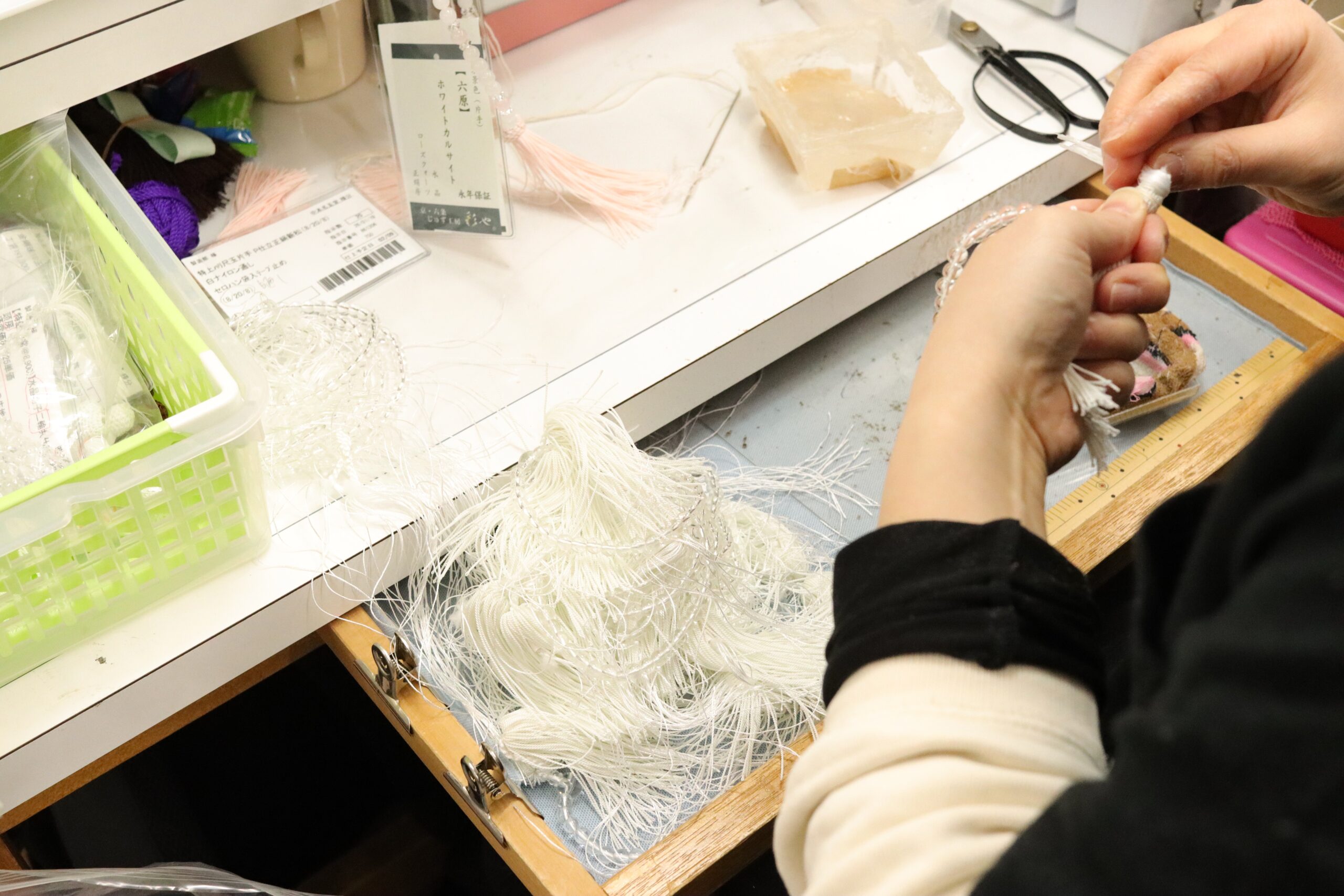
There, many artisans were working on repairment; they were divided into several sections, and each section took on their field of expertise—the labor-intensive industry, where all the processes are done with hands or tools.
The photo above is the scene where an artisan was repairing a Buddhist rosary.
This artisan was repairing a tassel by twisting and weaving several strings. It is more difficult than it looks. If one wrong step is taken, it won’t be a tassel.
This artisan was putting the finishing touches on prayer beads by attaching a tassel to them.
Summary
I was so excited to make my own amulet bracelet and learn about the creation and repair process of Buddhist rosaries. I was able to make my own bracelet even if I’m all thumbs, thanks to a kind artisan’s help. The workshop was cozy and relaxed, and it was an exciting hour that flew by before I knew it.
To those who would like to experience and learn about one of the spiritual aspects of Japan, I highly recommend this experience! Once you enter the shop, I bet you will be tempted to purchase some hand-made Buddhist rosaries as souvenirs, or you might purchase one for yourself, so that you can use it when you visit Buddhist temples.
The detached workshop is worth visiting, since you can learn more about the process of making prayer beads. You can not only see the sights, but also a shop clerk will guide you through the process.
Whether you are Buddhist or not, this workshop is a must-visit in Kyoto if you’d like to jazz up and spiritualize your journey!
Shop Information
Shop name: Kyoto KORIN
Location: Ushitoracho Shimogyo-ku,Kyoto-shi, Kyoto, Japan
Business hours: Mon-Fri 10:00-17:00, closed every Saturday and Sunday